Two-Way Radios and Emergency Weather Radios: A Starter Guide
Two-way radios let people communicate with each other; emergency weather radios receive broadcasts and alerts. Choose based on whether you need to reach your group, hear official weather information, or do both.
On this page (11 sections)
- What do two-way radios do?
- What does FRS or GMRS mean?
- What are emergency weather radios for?
- Can one radio handle communication and weather alerts?
- Which emergency radio power options should you consider?
- How should you choose a radio for your situation?
- How do range and obstacles affect two-way radios?
- How do NOAA Weather Radio channels and alerts work?
- What else should you check before buying?
- Which related radio guides should you read next?
- Which two-way radio or weather radio should you choose?
Two-way radios let people communicate with each other; emergency weather radios receive broadcasts and alerts. Choose a two-way radio when your group needs to stay in touch without relying on cell service, and a weather radio when you need a way to hear official weather information.
Some radios combine these functions. A combination can be useful, but features vary: a weather alert does not make a radio a substitute for a separate communication plan.
Start with the job you need the radio to do. Then check the radio service, licensing rules, power options, alert features and the conditions where you expect to use it.
What do two-way radios do?
A two-way radio sends and receives voice messages on a shared radio channel. A person talks into one radio, and other radios set to compatible channels can receive the transmission.
A basic handheld pair can help a family, crew or group coordinate over a local area. Unlike a phone call, this is usually a shared channel: people using that channel may hear your conversation, and you may hear theirs.
The name walkie-talkie often refers to a handheld two-way radio. Models differ in service, allowed power, features and the rules for transmission.
The radio’s advertised range is not a promise of how far it will work in your setting.
For a short family outing, simple controls and easy pairing may matter more than a long feature list. On a job site or trip where you need more control over channels and coverage, learn which service the radio uses before you buy.
Two common services for consumer handheld radios in the United States are FRS and GMRS. They share some frequencies, but their equipment and licensing rules differ.
Read what GMRS is and whether you need a license before choosing a GMRS radio.
What does FRS or GMRS mean?
FRS and GMRS are radio services with different operating rules. FRS radios are license-free when operated within FRS rules; GMRS generally requires an FCC license in the United States.
FRS is often a fit for straightforward, short-range communication with compatible radios. A radio marked FRS is not automatically compatible with every other radio in every setting, so check the channel plan and instructions.
GMRS may suit a group that wants to use GMRS handheld or mobile radios. GMRS radios can also use repeaters, which receive and retransmit a signal to extend coverage when the equipment and repeater are set up for that use.
A repeater does not guarantee a specific range. See what a GMRS repeater does and how far a GMRS radio can reach.
Before transmitting, check the service rules and your radio’s permitted channels. The FCC explains Personal Radio Services, including FRS and GMRS.
What are emergency weather radios for?
An emergency weather radio receives public broadcasts and may alert you to hazards. It does not send voice messages to another person like a two-way radio.
NOAA Weather Radio All Hazards broadcasts weather and other emergency information. A weather radio may let you listen to a broadcast, scan for an available channel or sound an alert.
Some models also support county-based S.A.M.E. programming, which can help limit alerts to selected areas.
The right setup depends on where you need to receive alerts. At home, a radio with county programming and adjustable alert choices may suit a fixed location.
For a go-bag or outdoor use, consider how you will power the radio and whether you need features such as a flashlight.
The Midland WR400 Weather Radio Deluxe offers S.A.M.E. programming for up to 25 counties, several alert options and battery backup with 4 AA batteries. It also has an alarm clock and AM/FM radio.
For a closer look at Midland’s weather-radio models, see Midland WR120, WR400 and ER310 compared. To understand what the broadcast channels mean, read the 7 NOAA Weather Radio frequencies explained.
Can one radio handle communication and weather alerts?
Some two-way radios include weather scan or alert features, but their main job is still communication. Check the exact model’s weather functions and alert controls before relying on it as your only source of emergency information.
A two-way radio with weather reception can reduce the number of devices you carry. Yet it may not provide the same alert settings or everyday listening experience as a dedicated weather radio.
For example, the Midland GXT1000VP4 GMRS Radios, 2 Pack includes NOAA scan and weather alerts, along with two radios and rechargeable battery packs. It uses GMRS, so check licensing requirements before transmitting.
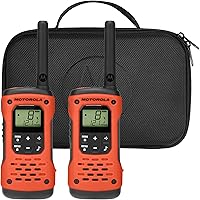
The Motorola Talkabout T605 H2O is an FRS two-way radio pair with a water-activated flashlight and a design that floats face up. It is waterproof with an IP67 rating, and the radios use USB-C charging.
Those details may suit water-based outings, but don’t treat an FRS radio as a dedicated weather-alert receiver unless its exact functions meet your needs.
If the weather alert function is your priority, compare it directly with a dedicated alert radio. Our guide to the best NOAA weather radios covers radios intended for that role.
Which emergency radio power options should you consider?
Choose a power plan you can maintain before an outage. A radio that depends on a single power source may be less useful if that source is unavailable when you need it.
A plug-in home radio can stay ready in a fixed location, while battery backup can keep it running during a power outage. Check which batteries are required and whether they are included.
For a portable emergency radio, consider rechargeable batteries, replaceable batteries, hand cranking or other power options listed for the specific model.
The Midland ER310 Emergency Crank Radio is a portable option with a built-in flashlight. It supports multiple power sources, NOAA Weather Scan and Alert, and USB connectivity.
A hand crank can be one part of a power plan, not a guarantee of continuous radio or phone use. Review whether a hand-crank radio can charge your phone and battery versus hand-crank radio options before choosing.
How should you choose a radio for your situation?
Match the radio to the people, place and task. A home alert radio, a pair of handheld walkie-talkies and a GMRS setup solve different problems.
| Your main need | Start by comparing | Check before you buy |
|---|---|---|
| Receive alerts at home | Dedicated weather radio | County settings, alert types, power backup and reception |
| Keep a group in touch nearby | FRS handheld pair | Channel compatibility, controls, battery plan and obstacles |
| Use GMRS handhelds | GMRS radios | FCC license, channel use, charging and any repeater plans |
| Communicate around water | Water-resistant or waterproof handhelds | The exact rating, handling needs and battery plan |
| Prepare for an outage away from an outlet | Portable emergency radio | Power sources, alert functions, lights and charging connections |
Make a short list of where the radio will be used and who needs to operate it. A radio with more buttons or channels can be a poor fit if everyone needs a very simple device.
For a family, agree on the channel and a backup channel before separating. Explain how to hold the radio, how to take turns speaking and what to do if a message does not get through.
If your group uses walkie-talkies, learn how channels and privacy codes work. Privacy codes do not make a conversation private; they help filter which transmissions your radio plays through its speaker.
How do range and obstacles affect two-way radios?
Actual range depends on the radio, terrain, buildings and other conditions. A maximum range printed in product information cannot tell you what to expect between two particular locations.
Hills and buildings can block or weaken radio signals. Dense surroundings, distance and interference can also affect communication.
A clear path between radios usually gives the signal fewer obstacles than a route through buildings or uneven terrain.
Think through your route rather than relying on one range figure. If you will be hiking, skiing or traveling through a large site, identify where your group could become separated and what you will do if a radio call fails.
For a GMRS system, coverage may depend on whether you are using a direct radio-to-radio connection or a repeater. See how far a GMRS handheld may reach for the factors to consider.
Before a trip, try the radios in the kind of area where you expect to use them. Confirm both units are on the same permitted channel and that each person can hear and reply.
A successful check at one location does not guarantee coverage everywhere on the route.
How do NOAA Weather Radio channels and alerts work?
NOAA Weather Radio uses broadcast channels, while alert settings help a receiver notify you about hazards. The channel you receive depends on your location and reception.
A weather radio may scan available weather channels to find a strong signal. Models with S.A.M.E. programming can be configured for selected counties, and some models let you choose how alerts sound or display.
Find the channel that serves your area and check the receiver in its intended location. An indoor radio’s reception can depend on placement and signal conditions, so test it before you need it.
Keep its power source ready as well.
Read NOAA Weather Radio frequencies and channels for a channel-by-channel explanation. If an alert radio beeps or stops receiving a signal, use our NOAA weather radio troubleshooting guide.
A weather alert tells you to pay attention to official information. Learn what a weather watch and warning each mean so you can choose the right next step when an alert arrives.
What else should you check before buying?
Check the radio’s service, power needs and controls against your actual plan. A feature only helps if it fits the way you will use and maintain the radio.
- Service and rules: Confirm whether the radio uses FRS or GMRS, and review the applicable FCC rules.
- Power: Check the power sources, battery type and whether batteries are included.
- Alert setup: For a weather radio, check channel scanning, county programming and alert options.
- Controls: Make sure the people using it can find the channel, volume and alert controls.
- Environment: Consider water exposure, handling and where the radio will be stored.
- Accessories: Check what comes with the radio, such as chargers, cables, belt clips or earpieces.
Some radios offer a long feature list but still may not suit your main task. Choose a dedicated weather receiver when dependable weather alerts are your priority, and a compatible two-way pair when you need to talk with another person.
Which related radio guides should you read next?
Start with the guide that matches your next decision. The related articles below cover weather alerts, GMRS and walkie-talkie use.
- Compare the Midland WR120, WR400 and ER310 weather radios if you are choosing among those models.
- Learn the 7 NOAA Weather Radio channels or what a watch and warning mean.
- Troubleshoot a radio that is beeping or not working.
- Learn what GMRS is, how repeaters work and which GMRS channels to use.
- See whether walkie-talkies work on a cruise ship and how to choose walkie-talkies for cruise ships.
- Compare walkie-talkies for skiing, hiking or water use.
- Compare Motorola T470 and T475 radios or Midland T51VP3 and T71VP3 radios.
- Find dedicated options in our best GMRS handheld radios and best GMRS mobile radios guides.
- Explore best hand-crank radios or Kaito KA500 versus Midland ER310.
- For model details, read our reviews of the Midland ER310PRO, Midland WR120B, Midland MXT275 and Midland GXT67 PRO.
- Compare Midland MXT275 and MXT115 PRO mobile radios.
Which two-way radio or weather radio should you choose?
Pick a dedicated weather radio if receiving alerts is the main job, and choose a compatible two-way pair if your priority is talking with your group. Consider a radio with both functions only after confirming its alert features, radio service and power plan fit your needs.
If you need a home alert receiver, compare alert options and backup power. If you need handheld communication, decide between FRS and GMRS, then check the rules and channels before using it.
The NOAA Weather Radio All Hazards program provides official information about broadcasts and alerts. Use it alongside a radio that fits your location and emergency plan.
Frequently asked questions
What is the difference between a two-way radio and a weather radio?
A two-way radio sends and receives voice messages between compatible radios. A weather radio receives broadcasts, such as NOAA Weather Radio, and some models sound an alert for hazards.
A two-way radio may include weather scan or alerts, but that feature does not make it a substitute for a dedicated alert radio.
Can walkie-talkies work without cell service?
Many walkie-talkies communicate directly with compatible radios, so they can work without a cell network when both radios have power and a usable radio path. Buildings, hills, distance and interference can reduce communication.
Check the radio type, permitted channels and license rules before using it.
Do I need a license for a GMRS radio?
In the United States, GMRS operation generally requires an FCC license, though the license covers eligible family members and does not require an exam. FRS radios are license-free when used within FRS rules.
Check current FCC requirements before transmitting, especially if you are choosing a radio with both services.
How far can two-way radios reach?
There is no single dependable range for every two-way radio. Terrain, buildings, antenna height, radio service, power and interference all affect the signal.
Treat a maker's maximum range as a best-case claim, then choose based on the distance and obstacles in your own setting.
Can one radio receive weather alerts and talk to another radio?
Some two-way radios include weather scan or alert features, so a single device may support both needs. Check the exact model's functions: weather reception does not mean it can send an alert to another radio, and a dedicated weather radio may offer alert controls that a walkie-talkie lacks.