Motorola T470 vs T475 Extreme: Which Talkabout? (October 2026)
For the Motorola T470 vs T475, choose the T470 for two boom mic headsets or the T475 for its carry case, earpiece and lanyard. Both pairs share FRS channels, NOAA weather radio and IPX4 protection.
On this page (10 sections)
- Motorola T470 vs T475: what changes?
- Who should choose the T470?
- Who should choose the T475?
- Which radio fits a hike, camp or family outing?
- What do their weather and alert features mean?
- How do channels and privacy codes work?
- How do you set up the T470 or T475?
- What mistakes should you avoid?
- When should you skip both radios?
- Which one should you buy?
For the Motorola T470 vs T475, choose the T470 if you want two boom mic headsets or the T475 if you want a carry case, earpiece and lanyard. Both are license-free FRS pairs with matching core radio features, so your choice comes down mainly to which included accessories you will use.
The T470 suits groups that want a headset for each radio. The T475 is a better fit if you want to keep the radios together in a case and value its earpiece and lanyard.


Motorola T470 vs T475: what changes?
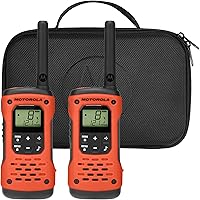
The main difference is the included accessory set. The T470 comes with two boom mic headsets, while the T475 comes with a carry case, an earpiece and a lanyard.
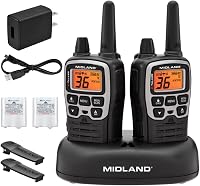
The T470 package also includes rechargeable batteries, belt clips, a charging adaptor with dual mini-USB connectors, personalization stickers and a user manual. Its stated battery life is up to 12 hours.
The T475 package includes rechargeable batteries, a charger, belt clips, personalization stickers, a carry case, an earpiece, a lanyard and a user manual. Its battery-life information conflicts: feature text says up to 12 hours, while its specs say 8 hours.
Plan charging around your schedule instead of relying on the longer figure.
The radios share 22 channels, 121 privacy codes, NOAA weather radio and alerts, a built-in flashlight, VibraCall alert and IPX4 weather protection. Neither is described as waterproof, so the T475's “Extreme” name shouldn't be taken to mean it can be submerged.
Who should choose the T470?
Choose the T470 if both people in your group will use the included boom mic headsets. A headset can keep a radio's speaker away from your ear and let you listen or speak without holding it up, which can be useful while walking or working with your hands.
It can suit a pair of hikers, event helpers or family members who want a headset for each radio. The belt clips also give you a way to carry the radios on clothing or a pack strap.
Check that the headset style works for each person before choosing this pair.
The T470 is less compelling if you won't use the headsets and would rather have a case, earpiece or lanyard. You can still use the radios without the headsets, but the T475's accessory set may better match that preference.
The stated battery life is up to 12 hours with the included NiMH batteries. Real use varies with how often you transmit, how you charge the radios and the conditions around you, so take the charging adaptor along on longer outings.
Who should choose the T475?
Choose the T475 if you want a carry case and expect to use the included earpiece or lanyard. The case gives the pair a dedicated place between outings, while the lanyard offers another way to keep a radio close at hand.
This bundle is a practical match for car trips, campsites and family activities where keeping small accessories together matters. The earpiece may help when you want to listen more discreetly or keep the radio speaker away from others.
The T475 may not be the best fit if two boom mic headsets are your main reason for buying. Its included earpiece is not the same accessory as a boom mic headset, and the T470 is the direct choice for a pair of boom mic headsets.
There is also a mismatch in the T475's stated battery-life information: one feature description gives up to 12 hours, while its specifications give 8 hours. If you need dependable communication through a long day, charge the radios fully before leaving and bring a charging option that fits your plans.
Which radio fits a hike, camp or family outing?
For walking and casual outdoor use, choose according to how you will carry the radios and whether you want headsets. The T470's two boom mic headsets suit people who want that accessory on both radios; the T475's case and lanyard suit people who prioritize storing and carrying the pair together.
Before a hike, agree on a channel and privacy code and check that both radios use the same settings. Leave the radios easy to reach, and keep a charged pair of batteries or a charging plan in mind for longer outings.
At a campsite or family park, the T475 case can help keep the pair and its small accessories together when not in use. The T470's headsets can make sense when the users prefer listening through an earpiece while moving around.
Neither IPX4 radio is the right choice for use where it may be submerged. If you need a waterproof design, compare options in our waterproof walkie-talkies guide, which includes the T605 H2O.
For more trail-specific buying advice, see our guide to walkie-talkies for hiking. It can help you think through what matters beyond the accessory bundle, including the route and the way your group plans to stay in touch.
What do their weather and alert features mean?
Both the T470 and T475 include NOAA weather radio and alerts, plus IPX4 weather protection. Those features help make them useful for outdoor trips, but they do not make either radio waterproof or replace a separate emergency plan.
NOAA weather radio can provide weather information when reception is available in your area. Check reception before relying on the feature, and keep another way to receive critical alerts if conditions or terrain may block the signal.
IPX4 is weather protection, not protection for submersion. Keep both models out of water, follow the care instructions and dry them if they get wet.
The T605 H2O is a different choice for wet environments. It has an IP67 waterproof rating and floats face up.
It also has a water-activated flashlight. Its listed features do not specify NOAA weather alerts, so weigh that difference if weather updates are part of your decision.
How do channels and privacy codes work?
The T470 and T475 each have 22 channels and 121 privacy codes, but privacy codes do not make a conversation private. They can filter transmissions you hear, while other radios using the same channel and code may still receive your conversation.
Before separating, set both radios to the same channel and code and have everyone in the group confirm the settings. If you can hear other users, try another channel and code combination, then share the new settings with the group.
A quick radio check before you head out can catch a mismatch while everyone is still together. Our guide to walkie-talkie channels and privacy codes explains channel selection and what privacy codes can and cannot do.
Both models are license-free FRS radios. If you are considering a GMRS radio instead, read what GMRS is and whether you need a license before you buy, because those radios have different licensing rules.
How do you set up the T470 or T475?
Charge both radios, choose matching channel settings and confirm that each person can hear the other before you leave. A short setup check helps prevent an accessory or settings mismatch from becoming a problem on the trail or at an event.
First, identify the charger and battery arrangement included with your chosen model. The T470 includes a charging adaptor with dual mini-USB connectors.
The T475 includes a charger. Use the right charging equipment and follow the radio's manual.
Next, attach the belt clips or the accessory each person expects to use. With the T470, check that each boom mic headset is comfortable and positioned where the user can speak clearly.
With the T475, decide whether the earpiece or lanyard will be used and keep the carry case for storage.
Then, turn on both radios and set them to the same channel and privacy code. Test a short message in both directions, including from a realistic distance within your group, and make sure everyone knows how to use the controls they need.
Finally, turn on NOAA weather radio or alerts according to the manual and confirm you can receive a signal where you are. Weather reception varies by location, so treat this as one useful feature within a broader plan.
What mistakes should you avoid?
The biggest mistakes are treating privacy codes as privacy, assuming IPX4 means waterproof and leaving without checking that the radios match. A few simple checks can prevent these common problems.
Don't set one radio to a different channel or code from the other. If the radios don't communicate, check those settings first before assuming something is wrong with the equipment.
Don't count on a privacy code to protect sensitive conversations. It filters what you hear; it does not encrypt your message or stop another radio from receiving it.
Don't take either the T470 or T475 into water where it could be submerged. Their IPX4 protection is different from the T605 H2O's IP67 waterproof rating.
Don't assume the T475 will run for 12 hours just because one feature description says so. The stated figures conflict, so charge it fully and plan for a recharge if your outing may last all day.
Finally, don't leave accessory setup until you are already separated. Try the headset, earpiece or lanyard in advance and agree on who carries each radio.
When should you skip both radios?
Skip the T470 and T475 if you need an IP67 waterproof radio or if neither model's accessory bundle fits your use. Their shared IPX4 protection is for weather exposure, not submersion, and the main distinction between them is what comes in the box.
Choose the T605 H2O instead when a radio could fall in water or you want one that floats face up. If you need NOAA weather radio and alerts, note that the T605 H2O's listed features do not specify them.
You may also want a different radio if your group needs a GMRS model or a different radio setup. The T470 and T475 are FRS radios, so compare your requirements before choosing a model.
For more options, browse our walkie-talkie guides and comparisons.
Which one should you buy?
Choose the T470 for two boom mic headsets, the T475 for a carry case with an earpiece and lanyard, and the T605 H2O if waterproofing matters most. For the Motorola T470 vs T475 decision, pick the accessory bundle you will actually use and account for the T475's conflicting battery-life figures.
The T470 is the straightforward choice for two users who want boom mic headsets. The T475 is the better match for users who value its case and carrying accessories.
If neither bundle fits, or you need water protection beyond IPX4, look at another model.
For more options by use, browse our walkie-talkie guides and comparisons.
Frequently asked questions
What is the difference between the Motorola T470 and T475?
The clearest difference is what comes with each pair: the T470 includes 2 boom mic headsets, while the T475 includes a carry case, earpiece and lanyard. Both have 22 channels, 121 privacy codes, IPX4 protection, NOAA weather radio and alerts, and a built-in flashlight.
Is the Motorola T475 waterproof?
The T475 has IPX4 weather protection, which is not the same as a waterproof rating. The T605 H2O has an IP67 waterproof rating and floats face up.
For trips where a radio could be submerged or dropped in water, compare the protection ratings and follow the radio's instructions.
Do the T470 and T475 have NOAA weather alerts?
Yes. Both the T470 and T475 have NOAA weather radio and alerts.
The T605 H2O's features do not specify NOAA weather alerts, so don't assume it offers this feature when choosing a radio for weather updates.
Do you need a license for the Motorola T470 or T475?
Both radios are license-free FRS models. GMRS radios have separate licensing rules.
Read our guide to what GMRS is and whether you need a license before choosing a GMRS model.