Rocky Talkie vs Midland Radio: Which to Buy? (November 2026)
The Rocky Talkie Expedition 5 Watt wins for most backcountry users thanks to GMRS range, 5-day battery life and IP67 waterproofing. Pick the Rocky Talkie Mountain Radio for license-free simplicity and the lowest cost of the two.
On this page (8 sections)
- Rocky Talkie vs Midland radio: which should you buy?
- The two radios side by side
- Range: how far will each radio actually reach?
- Battery life and charging: which lasts longer?
- Durability and mounting: how each radio rides on your pack
- Weather alerts and extra features
- Who should buy which?
- Verdict: which radio wins?
The Rocky Talkie Expedition 5 Watt is the better buy for most backcountry users. It runs on GMRS with 5 watts of power, adds repeater channels and carries an IP67 waterproof rating.
The Rocky Talkie Mountain Radio is the smarter pick for casual walkers who want no license and simple controls. In this Rocky Talkie vs Midland radio comparison, service type and trip length decide the winner more than brand name.

 Best for license-free everyday use
Mountain Radio Long Range FRS Radio
Rocky Talkie vs Midland radio: which should you buy?
Buy the Expedition 5 Watt if you hike or hunt far from cell coverage and want the strongest handheld signal. Choose the Mountain Radio if you want a pair that works straight from the box without a license.
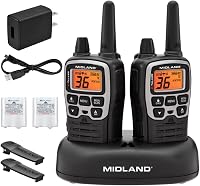
The "Midland" side of this comparison covers the Midland X-Talker line as a category. The Midland X-Talker T51VP3 review explains what that family offers for casual users.
Rocky Talkie built both radios for the outdoors. The Expedition targets long trips and repeater use, while the Mountain Radio targets simple, license-free communication.
Both ship as 2-packs. That matters for couples, hiking partners and families who need matched radios on the same trip.
Each pair also shares the same two-year Rocky Talkie warranty against defects in materials and workmanship, so the coverage is even even though the radios are not.
The two radios side by side
The Expedition wins on power, weather protection and battery life; the Mountain Radio wins on simplicity and licensing. The table below lines up the specs that separate them.
| Product | Best for | Service | Power | Water rating | Our score |
|---|---|---|---|---|---|
| Rocky Talkie Expedition 5 Watt Radio | long backcountry trips | GMRS | 5 W | IP67 | 9.6 |
| Mountain Radio Long Range FRS Radio | license-free everyday use | FRS | 2 W | IP56 | 8.0 |
| Feature | Expedition 5 Watt | Mountain Radio |
|---|---|---|
| Radio service | GMRS | FRS |
| Transmit power | 5 W | 2 W |
| License needed | Yes | No |
| Water rating | IP67, 1 m submersion | IP56, splashes and snow |
| Battery life | About 5 days | About 4 days |
| Channels | 22 plus 8 repeater channels | 128 |
| Antenna | Removable, 7.5 cm and 17 cm options | Fixed |
| Mounting | Steel gator clip and backup leash | Climbing carabiner and backup leash |
| Best for | Long backcountry trips | Everyday and short trips |
The channel counts look lopsided, but they measure different things. The Expedition's 22 channels include the GMRS set plus repeater slots.
The Mountain Radio's 128 channels give it more room to roam on FRS.
What the GMRS and FRS labels mean
GMRS radios need an FCC license in the US. FRS radios don't.
That's the single biggest practical split between these two.
The Expedition's 5 watts is the most power allowed for a handheld GMRS radio. The Mountain Radio's 2 watts is the most allowed without a license.
Both use UHF tuning, which is the band that keeps handheld signals working through timber and around modest terrain features.
Many channels are shared between the two services. If your group mixes both radio types, confirm the channel plan before you split up on the trail.
Why the waterproof ratings differ in practice
The Expedition carries an IP67 rating. Rocky Talkie says it survives submersion up to 1 meter.
That matters for river crossings, rainstorms and kayak trips.
The Mountain Radio carries an IP56 rating. Rocky Talkie says it handles splashes and snow.
It's fine for most hiking, but it isn't built for a dunking.
If your trips involve water, the rating gap alone can decide the choice. Our walkie-talkies category covers more pairs built for wet conditions.
Range: how far will each radio actually reach?
The Expedition reaches farther because it transmits more power and can use repeaters. Rocky Talkie puts both radios at over 35 miles in ideal conditions.
Real terrain cuts that down. Rocky Talkie says 2 to 8 miles is typical for the Expedition in backcountry terrain.
The Mountain Radio drops to about 1 to 5 miles. Those figures assume open ground and a clear path, so treat them as a ceiling rather than a promise.
Line of sight matters more than raw wattage. Ridges, dense timber and canyon walls all cut signal, so plan radio checks at trail junctions and camps.
A 5-watt signal still bends around fewer obstacles than a 2-watt one, which is why the Expedition holds contact longer in broken country.
Repeater access changes the math
The Expedition gives you access to 8 repeater channels. A repeater picks up your signal and rebroadcasts it, which can stretch your reach across a valley or over a ridge.
The radio supports dual-channel monitoring and transmitting, so you can keep a repeater channel and a direct channel live at the same time.
That's a real advantage in areas with a local GMRS repeater network. Check what's active near your usual trails before you count on it.
The Mountain Radio has no repeater access. It talks radio to radio, which is fine for pairs staying close together.
Antenna options on the Expedition
Rocky Talkie includes a 7.5 cm antenna already installed and a 17 cm option in the box. The removable mount lets you swap to the longer antenna when you want more reach, and the radio is compatible with GMRS antennas and headsets.
The Mountain Radio uses a fixed antenna. That keeps it simple, but you can't change it later.
It's designed to pair with other Rocky Talkie Mountain Radios, so check compatibility before you pair it with a different brand.
Battery life and charging: which lasts longer?
The Expedition lasts about 5 days per charge, one day longer than the Mountain Radio. Both use replaceable lithium-ion batteries and charge over USB-C.
Cold weather is the real test. Rocky Talkie says both batteries hold up in frigid conditions, which matters for winter trips and ski tours.
The Expedition's 1800 mAH cell is the one rated for about 5 days, while the Mountain Radio's lithium-ion pack is rated for over 4 days.
A dead radio at dusk is a safety problem. Charge both pairs before a trip and carry a power bank for longer outings.
What's in each box
The Expedition ships with 2 radios, 2 lithium-ion batteries, 2 USB-C cables, 2 steel gator clips and 2 backup leashes. It also includes the 17 cm antennas as an option.
The green colorway is the only one available for this pair.
The Mountain Radio ships with 2 radios, 2 lithium-ion batteries, 2 USB-C cables, 2 climbing-rated carabiners and 2 backup leashes. There's no second antenna, but the carabiner mount is part of the package.
This pair comes in black.
Neither pair includes a hand mic. Rocky Talkie sells one separately for the Mountain Radio.
Charging habits that keep radios ready
Top off both radios the night before a trip. Lithium-ion cells lose charge slowly, so a radio left in a pack for a month may need a full charge.
Keep the USB-C cable with your trip gear. A short cable and a small power bank cover a weekend without a wall outlet.
Because both batteries are replaceable, you can also carry a spare cell instead of relying on a charger alone.
Durability and mounting: how each radio rides on your pack
Both radios are built to survive drops, but the Expedition adds full submersion protection. Rocky Talkie gives both a shatterproof LED screen and a thermoplastic protective covering.
The Expedition attaches with an integrated steel gator clip that rotates 360 degrees. A metal-reinforced backup leash adds a second line of defense.
Rocky Talkie also offers a separate carabiner attachment for this radio, built with a Colorado partner, if you prefer that style of mount.
The Mountain Radio attaches with a Trango Quantum climbing-rated carabiner and a metal-reinforced backup leash. Rocky Talkie says it avoids the fragile plastic clips common on other radios.
Clipped to a shoulder strap or stowed in a pack?
The gator clip on the Expedition suits a shoulder strap or belt. The 360-degree rotation lets you angle the screen toward you.
The Mountain Radio's carabiner suits a harness loop or pack strap. It's a lighter, more climbing-focused mount.
The steel clip on the Expedition is the sturdier of the two, while the carabiner is easier to clip on with one hand.
Either way, keep the antenna clear of your body. A radio pressed against your chest loses some reach.
Screen and controls in the field
Both screens are shatterproof LED. The Mountain Radio has 5 buttons and needs no setup, which helps in gloves or low light.
The Expedition adds dual-channel monitoring. You can listen on two channels at once, useful when your group uses a primary and a backup.
If you want to compare the smaller Midland X-Talker bodies against each other, the Midland X-Talker T51 vs T71VP3 breakdown covers the differences.
Weather alerts and extra features
The Expedition includes NOAA weather alerts and 11 weather channels; the Mountain Radio skips weather features. That's a real safety gap for exposed trips.
NOAA broadcasts cover forecasts, watches and warnings. A radio that receives them gives you a second source when cell service drops.
The Expedition's 11 weather channels are built in, and the alert function flags watches and warnings as they come through.
The Expedition also offers dual-channel monitoring. You can keep a weather channel open while staying on your group's talk channel.
Who needs weather alerts?
Hikers, hunters and paddlers in remote country benefit most. Weather can turn fast above tree line, and a radio alert buys time.
Casual users on short suburban walks rarely need them. The Mountain Radio's simpler feature set fits that use better.
License-free simplicity on the Mountain Radio
The Mountain Radio works out of the box with zero configuration. Five buttons and 128 channels cover the basics without a manual.
That's the radio to hand a kid or a first-time hiker. No license, no setup, no channel programming.
The trade-off is reach. Without GMRS power or repeaters, the Mountain Radio stays a short-range tool.
It's also the more approachable of the two for a group that has never used radios before.
Who should buy which?
Buy the Expedition 5 Watt for long trips, repeater areas and wet conditions. Buy the Mountain Radio for casual walks and groups that don't want a license.
The Expedition fits backpackers, hunters and ski tourers who range far from roads. Its 5-day battery and IP67 rating cover multi-day trips and river crossings.
The repeater access is the tiebreaker for anyone who lives near an active GMRS network.
The Mountain Radio fits families, day hikers and anyone who wants to hand a radio to a beginner. The climbing carabiner and no-license setup keep it easy.
The carabiner also makes it the friendlier pair for climbers who already carry climbing-rated hardware.
The Rocky Talkie vs Midland radio call for casual users
For light use around town, a Midland X-Talker pair can be the budget route. The T51VP3 line is built for simple, close-range talk.
Our Kaito KA500 vs Midland ER310 crank radio comparison covers the emergency-radio side if backup power matters to you. A crank radio and a walkie-talkie pair solve different problems.
Matching radios to your group
Everyone in your group should use the same service for reliable contact. Mixing GMRS and FRS works on shared channels, but power limits still apply to the FRS radios.
If one person carries the Expedition and another carries the Mountain Radio, the FRS radio caps the group's reach. Match the pairs when you can.
Buying two of the same pair also means one spare battery type and one set of accessories across the group.
Verdict: which radio wins?
The Rocky Talkie Expedition 5 Watt wins this Rocky Talkie vs Midland radio matchup for most buyers. It packs 5 watts of GMRS power, 8 repeater channels, IP67 waterproofing and a 5-day battery into one pair.
The Mountain Radio is the right pick when license-free simplicity and price matter more than reach. It's ready to use out of the box and mounts with a climbing carabiner.
Pick the Expedition if you hike far, cross water or want weather alerts. Pick the Mountain Radio if you stay close to home and want to skip the license.
Either way, buy a matched 2-pack and test both radios before your trip. A quick radio check at the trailhead beats a silent pack halfway up the mountain.
Frequently asked questions
Do you need a license for a Rocky Talkie radio?
The Expedition 5 Watt Radio runs on GMRS, which requires an FCC license in the US. The Mountain Radio uses FRS and needs no license, so it's the simpler choice for casual users.
What is the real range of these radios?
Rocky Talkie says both radios reach over 35 miles in ideal conditions. In backcountry terrain, expect about 2 to 8 miles from the Expedition and 1 to 5 miles from the Mountain Radio.
Which radio has the better battery life?
The Expedition 5 Watt Radio has the longer battery, lasting about 5 days on a charge. The Mountain Radio lasts about 4 days.
Both use replaceable lithium-ion batteries and charge over USB-C.
Is the Rocky Talkie Expedition worth it over the Mountain Radio?
It's worth it if you hike far from roads and need repeater access or a longer battery. The Mountain Radio covers short trips and everyday use without a license, so it's the better value for casual walkers.