How to Choose a Walkie Talkie
Choose a walkie talkie by matching its power and channels to where you'll use it: a license-free FRS pair for casual family and outdoor use, a GMRS radio when you need more reach or repeater access, and an IP67-rated set when water or dust is likely. Check the battery life and privacy codes before you buy.
On this page (9 sections)
- What range should you expect from a walkie talkie?
- Which radio service fits your use?
- How much power do you need?
- Which channels and privacy codes matter?
- Should you pick FRS or GMRS for family use?
- How important is weather resistance?
- How long should the battery last?
- Which extras are worth paying for?
- Which walkie talkie should you pick?
Learning how to choose a walkie talkie comes down to one question: where will you actually use it? A license-free FRS pair covers casual family trips and short outdoor outings.
A GMRS radio makes sense when you need longer reach or repeater access.
A waterproof set earns its keep around water, snow or dust.
Power, service type, channel count, privacy codes and battery life decide whether two radios will talk clearly across the distance you need.
This guide walks through each one in the order that matters.
What range should you expect from a walkie talkie?
Treat printed range as a best-case number measured in open country, not as the distance you'll get in town. A radio rated for 28 miles will not cover 28 miles through hills, trees or buildings.
Range falls fast once obstacles appear. A ridge, a dense forest or a row of houses each cut the signal.
Two radios on flat open ground can talk much farther than the same pair in a suburb full of walls.
Manufacturers quote their numbers under ideal conditions. That makes the figure useful for comparing radios from the same maker, and less useful for predicting your own trip.
A 2-watt radio and a 5-watt radio both lose reach in the same rough terrain; the stronger one just starts further ahead.
Here is how the three radios in this guide compare on reach.
| Radio | Power | Quoted maximum range | Best setting |
|---|---|---|---|
| Midland T51VP3 X-Talker | FRS | Up to 28 miles | Casual family and short outdoor trips |
| Midland GXT67 PRO | 5W GMRS | Up to 100 miles, repeater capable | Open country, trails and worksites |
| DEWALT DXFRS800 | 2W FRS | Up to 2 miles, or 300,000 sq ft | Large sites and multi-floor buildings |
The pattern is simple. More power buys more reach in open terrain.
Buildings and floors suit the shorter, cleaner signal of a 2-watt set. Match the quoted range to your terrain and your worst-case distance, then add a margin.
Which radio service fits your use?
The service type decides your reach and your paperwork. FRS needs no license and covers everyday use, while GMRS needs an FCC license and gives you more power and repeater access.
FRS, the Family Radio Service, runs on 22 channels in the UHF band. Anyone can use it without a license, which is why most two-packs sold for family and outdoor use are FRS radios.
The Midland T51VP3 and the DEWALT DXFRS800 both operate on FRS channels.
GMRS, the General Mobile Radio Service, shares some frequencies with FRS but allows more power and repeater use. The Midland GXT67 PRO pushes a full 5 watts and connects to local GMRS repeaters to extend its range by dozens of miles.
The catch is the license: one FCC license covers the operator's household, and it's worth having before you rely on the radio.
For a family hike or a theme park day, FRS is the simpler choice. For a trail group spread over miles or a worksite with poor cell coverage, GMRS earns the license.
If you already know your trips are mountain or snow days, our roundup of the best walkie talkies for hiking narrows the field further. For winter trips, the best walkie talkies for skiing covers the cold-weather options.
How much power do you need?
Pick power by distance and obstacles, not by the biggest number. A 2-watt FRS radio handles a campsite or a building site; a 5-watt GMRS radio is the choice when your group spreads across open country.
Power is measured in watts of transmit output. The DEWALT DXFRS800 runs 2 watts and reaches up to 300,000 sq ft or 25 floors, which suits a large crew inside one building.
The Midland GXT67 PRO runs 5 watts, the legal limit for GMRS, and cuts through dense treelines and valleys better than a lower-powered radio.
Higher power costs battery life. The GXT67 PRO's high-capacity Li-Ion battery runs for days on the trail, while the T51VP3's battery packs last about 10 hours.
Both figures come from normal use, so a long day of constant talking shortens them.
When 2 watts is enough
A 2-watt radio keeps its advantage in close quarters. Inside a warehouse, a hotel or a ski lodge, walls and floors limit everyone's signal anyway, so the extra power of a 5-watt unit buys little.
The DXFRS800's 121 privacy codes help in crowded radio environments, where dozens of other users share the same FRS channels. Auto-squelch keeps the audio clean when the airwaves are busy.
Choose 2 watts for buildings, campuses and short-range group coordination.
When to step up to 5 watts
Step up when distance and terrain are the problem. A 5-watt GMRS radio with repeater access reaches far beyond what a 2-watt FRS pair can do in the same valley.
The GXT67 PRO arrives pre-programmed with 22 channels and 28 privacy codes, so it works out of the box without frequency programming. Its backlit display and oversized buttons are built for gloved hands on a trail.
Pick 5 watts for open country and repeater coverage. Stay with FRS if you want zero paperwork and shorter distances.
Which channels and privacy codes matter?
Look for 22 FRS channels at minimum, and 38 privacy codes if you'll share busy airwaves. More channels mean less chance of stepping on another group's conversation.
Channels are the shared frequencies. On FRS, all 22 are open to everyone, so a popular trailhead or resort can fill up fast.
Privacy codes sit on top of a channel and filter out calls that don't carry the same tone.
The Midland T51VP3 offers 38 CTCSS privacy codes. Combined with its 22 channels, Midland describes up to 836 channel options for blocking other conversations.
The GXT67 PRO lists 99 channels, with 22 pre-programmed plus 28 privacy codes ready to use.
A privacy code does not scramble your voice. It keeps your speaker quiet when another group is talking nearby.
Anyone tuned to your channel and code still hears you.
For a family on a busy beach, codes cut the noise. For two people on an empty ridge, they change little.
Choose more codes for crowded places, and fewer for quiet ones.
Should you pick FRS or GMRS for family use?
FRS is the better fit for most families. It needs no license, the radios are compact, and 22 channels cover a campsite, a mall or a neighborhood.
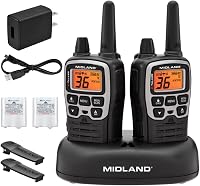
The Midland T51VP3 X-Talker is the easy family pick. The pair is compact enough to clip to a belt or slip into a pocket, and the 38 privacy codes keep the channel calm on a busy day.
NOAA weather scan checks 10 weather-band channels and locks onto the strongest one, and the weather alert sounds an alarm when severe weather is near.
Hands-free eVOX with three sensitivity levels means you can talk without pressing a button. That helps on a bike, in a kayak or while carrying gear.
Battery life runs about 10 hours, so pack spares for a full day out.
The T51VP3 is water resistant rather than fully waterproof. For rain, splashes or snow, a rated set is safer.
Our guide to the best waterproof walkie talkies covers models built for wet conditions.
Pick FRS for family trips and casual use. Move to GMRS only when distance or repeater access becomes a real need.
How important is weather resistance?
Weather resistance matters most when water, snow or dust will be part of the trip. An IP67 rating means the radio is protected against dust and short immersion in water, which is a real step up from water resistant.
The DEWALT DXFRS800 carries an IP67 rating plus an anti-slip housing built to withstand drops up to 2 meters. That combination suits a wet boat deck, a snowy slope or a dusty jobsite.
The Midland GXT67 PRO also lists IP67 protection in its feature set.
The Midland T51VP3 is water resistant, which covers light rain and splashes but not a dunk in a lake. For a family walk in drizzle, that's enough.
For skiing, kayaking or work in the rain, choose the rated radio.
Durability counts too. A radio that survives a 2-meter drop is worth more on a rocky trail than one that doesn't.
Pick IP67 when the environment is wet, snowy or dusty, and save the water-resistant pair for dry use.
How long should the battery last?
Match battery life to your longest day out, then add a spare. About 10 hours covers a normal outing; a multi-day trail trip needs a radio rated in days.
The Midland T51VP3 runs about 10 hours on its rechargeable packs, and the set includes a desktop charger and a micro USB cable. The DEWALT DXFRS800 runs up to 18 hours, which covers long shifts and full ski days.
The Midland GXT67 PRO's high-capacity Li-Ion battery lasts about 4 days on the trail.
Charge method matters as much as hours. The GXT67 PRO ships with AC and DC adapters, so you can charge it in a car between trailheads.
The DXFRS800 comes with a dual-port dock charger and two dock adapters for charging both radios together. The T51VP3 uses a desktop charger for the pair.
Plan for cold weather. Battery capacity drops in low temperatures, so a ski day drains a radio faster than a summer hike.
Carry a spare pack or a power bank for winter trips. The GXT67 PRO's lithium-ion pack handles the cold better than most, but no battery shrugs it off entirely.
Check the charge kit against your routine. A set that charges both radios in one dock, like the DXFRS800, means one outlet and no hunting for a second cable at bedtime.
A radio with car adapters, like the GXT67 PRO, covers the trailhead-to-campsite gap. For the T51VP3's 10 hours, spare packs or a power bank close the gap on a long day.
Choose 10 hours for day trips, 18 hours for long shifts, and multi-day ratings for backcountry use. A radio that dies at the trailhead is worse than no radio.
Which extras are worth paying for?
Pay for hands-free use, a clear display and charging accessories; skip extras you won't touch. The useful features are the ones you'll use on every trip.
Hands-free VOX lets you talk without pressing a button, which helps when your hands are busy. All three radios here support some form of it.
The T51VP3's eVOX has three sensitivity levels so you can tune it to your voice and background noise.
Hands-free modes and display comfort
Voice activation works best when you can tune it. Three sensitivity levels on the T51VP3 let you set how loud you must speak before the radio transmits, so wind or a running engine doesn't keep the channel open.
The GXT67 PRO offers a call alert for getting a partner's attention without a long transmission. The DXFRS800 pairs VOX with a vibration alert and a roger beep, so a crew member feels a call in a noisy room and hears when a message ends.
A backlit display and large buttons help in the dark or with gloves. The GXT67 PRO is built around that idea, with controls you can operate while wearing gloves.
The T51VP3 keeps things simple with a compact body and belt clips.
Weather alerts are a real safety feature for outdoor use. The T51VP3 scans 10 weather-band channels and sounds an alarm when severe weather is near.
If you hike or camp in storm country, that's worth having. The GXT67 PRO lists a weather alert as well.
Charging accessories save hassle. A dual dock charger, car adapters and spare battery packs all reduce the chance of running flat.
Spend on the features you'll use every trip, and skip the rest.
Which walkie talkie should you pick?
Pick the Midland T51VP3 X-Talker for most everyday use. It's a license-free FRS pair with weather alerts, privacy codes and hands-free eVOX, which makes it the simplest fit for family trips.
For family outings, campsites and casual trips, it covers the basics without paperwork.
Choose the Midland GXT67 PRO when reach is the priority. Its 5W GMRS output, repeater support and four-day battery suit trail groups and worksites in open country.
Just get the FCC license first.
Choose the DEWALT DXFRS800 when the job is wet, dusty or indoors. Its IP67 rating, 2-meter drop protection and 18-hour battery handle tough sites, and 121 privacy codes keep a crowded channel clean.
That's how to choose a walkie talkie: match the service to your paperwork tolerance, the power to your terrain, and the rating to your weather. For trip-specific picks, our guide to the best walkie talkies for a cruise ship covers shipboard use.
Our score weighs specs, features and buyer feedback against what you're shopping for. Whichever radio you pick, buy one per person and charge them all the night before you go.
Frequently asked questions
Do I need a license to use a walkie talkie?
FRS radios need no license, and most family walkie talkies sold as pairs run on FRS channels. GMRS radios like the Midland GXT67 PRO do require an FCC license for the person operating them.
Check the radio's service type before you buy.
How far will a walkie talkie actually reach?
Real reach is shorter than the maximum miles a maker prints. Hills, trees, buildings and walls all cut the signal, so two radios in open country talk much farther than two in a dense suburb.
Treat the printed figure as a best-case number, not a promise.
What do privacy codes actually do?
Privacy codes, also called CTCSS codes, filter out other people's chatter on the same channel rather than scrambling your voice. They keep your group's conversations quieter on a busy channel.
They do not make your calls secret from someone tuned to the same code.
How many radios should I buy?
Buy one radio per person who needs to talk. Pairs suit couples and small families, while three or more radios help larger groups stay in contact.
A two-pack usually costs less per radio than buying singles.
Are waterproof walkie talkies worth the extra cost?
An IP67 rating is worth it when you'll use radios near water, in rain or in dust. Skiers, boaters and wet-weather hikers get real protection from splashes and drops.
For dry indoor use, a water-resistant pair is usually enough.