CB Radio vs Walkie Talkie: Which Do You Need? (November 2026)
Pick a walkie talkie for short-range handheld use and a CB radio for vehicle-to-vehicle talk on the highway. In the cb vs walkie talkie choice, how far you need to reach and whether you'll be in a car or on foot decide it.
On this page (10 sections)
- What is the quick answer in CB radio vs walkie talkie?
- How do CB radio and walkie talkie differ side by side?
- Which radio reaches farther?
- Do you need a license for either radio?
- Which is easier to carry and use?
- Which is better for driving and road trips?
- Which is better on foot, at camp or at an event?
- Which costs less to set up?
- Who should buy which?
- What is the verdict in CB radio vs walkie talkie?
Pick a walkie talkie for short-range handheld use and a CB radio for vehicle-to-vehicle talk on the highway. In the cb vs walkie talkie decision, how far you need to reach and whether you'll be in a car or on foot decide it.
A walkie talkie rides in a pocket or pack and needs no license on FRS channels. A CB radio lives in a vehicle or on a desk, reaches farther on open road and needs a proper antenna to work well.
This comparison looks at range, licensing, power, portability and price tier so you can match the radio to the way you actually talk.
What is the quick answer in CB radio vs walkie talkie?
Most people should buy a walkie talkie; choose a CB radio only when vehicle talk or long open-road range is the job. The walkie talkie wins for camping, hiking, events, small crews and family outings because it's handheld and ready to use.
A CB radio earns its place when you drive with a group, work a ranch or want to monitor highway chatter. It needs vehicle power or a base setup and an antenna tuned to the band, so it's a fixed installation rather than a pocket tool.
The split is simple: handheld and short-range points to a walkie talkie; vehicle-mounted and longer-range points to CB. For a deeper look at how license-free radio families compare, our guide on what GMRS radio is explains where each service sits.
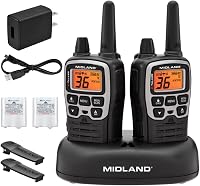
One more angle worth knowing before you shop. A walkie talkie set is a complete kit in a box: radios, batteries, a charger and often earpieces and belt clips.
The pxton 4-pack ships with four 1500 mAh lithium batteries, four charging stations, four belt clips, four earpieces and hand straps. A CB radio usually arrives as the radio alone, and you add the antenna, mount and wiring yourself.
How do CB radio and walkie talkie differ side by side?
They differ in band, power, antenna and how you carry them. CB runs on the 11-meter band near 27 MHz with higher transmit power and an external antenna.
Walkie talkies here run on FRS UHF channels near 462 MHz in a small body with a built-in antenna.
The table below puts the main differences in one place.
| Product | Best for | Packs | Channels | Battery | Our score |
|---|---|---|---|---|---|
| pxton Walkie Talkies Long Range for Adults | groups and family trips | 4 | 16 | 8-96 hours | 9.7 |
| MOICO Walkie Talkies for Adults | travel and camping | 2 | 22 | 9.6 | |
| pxton Walkie Talkies Rechargeable Long Range Two-Way | small crews | 2 | 16 | 8-96 hours | 9.5 |
| Retevis RT22 FRS Walkie Talkies, 4 Pack | light everyday carry | 4 | 16 | About 10 hours | 8.6 |
What the band difference means for you
CB's lower frequency bends around obstacles better over long distances, which suits open highway and rural areas. UHF walkie talkies punch through short ranges well but fade faster behind hills and buildings.
That's why a CB in a truck can reach several miles while a handheld walkie talkie usually covers about 0.5 to 2 miles. Antenna height does as much work as power in both cases.
What the power difference means for you
CB radios transmit at higher wattage, which helps push a signal farther. FRS walkie talkies are capped at low power by regulation, so their reach stays modest and honest.
More power doesn't fix bad terrain. A walkie talkie on a ridge can outreach a CB in a valley, so match the radio to where you'll stand or drive.
What the channel setup means for you
This is where the two systems feel most different in daily use. A CB radio has 40 standard channels, and you change channel with a dial while you also watch for skip and noise.
The walkie talkies here work a smaller, simpler menu.
The pxton 4-pack gives 16 preset channels chosen by turning a knob, plus 165 privacy codes to cut cross-talk. The MOICO pair runs 22 FRS channels with 99 CTCSS tones, which the maker lists as up to 2178 code combinations.
The Retevis RT22 keeps to 16 channels and a 0 to 9 squelch level for noisy rooms.
Privacy codes don't hide your voice from a scanner. They only filter out other talk on the same channel, which is why a busy campsite with a dozen radios needs them and a quiet highway rarely does.
Which radio reaches farther?
CB reaches farther in most real settings, especially from a vehicle with a good antenna. Walkie talkies win only when both people stay close and the ground is open.
The pxton four-pack lists a 2-mile top range in open areas, and the MOICO set lists up to 3 miles. Both makers note that towns, buildings and weather cut that figure, often to about 0.5 to 1 mile.
A CB radio with a mounted antenna on a car or truck routinely covers more ground on the highway. The trade-off is that CB needs that antenna and a power connection to deliver the range.
If your talk stays inside a campground or jobsite, a walkie talkie's shorter reach is plenty. For a convoy spread over several miles of interstate, CB is the better tool.
Retevis is blunt about this in its own notes. It says most FRS radios are usually within 0.5 to 2 miles, because FCC power limits and obstacles cap them, and that the multi-mile figures apply only to ideal line-of-sight cases.
Do you need a license for either radio?
Neither a standard CB radio nor an FRS walkie talkie needs a license for personal use in the US. GMRS radios do require one, and that's a separate service from both.
CB operation on the 40 standard channels is license-free for personal use. FRS walkie talkies like the Retevis RT22 are also license-free, which is why they're sold ready to use out of the box.
GMRS sits between the two: more power and repeater access than FRS, but a paid license is required. Our GMRS explainer covers that paperwork if you're leaning toward more range than FRS offers.
Licensing rarely decides the CB vs walkie talkie question, since both main options are license-free. It matters when you start comparing walkie talkies to GMRS.
If you plan to hand radios to a large group, the license-free point matters more than any spec. You can buy a four-pack for a family or a crew of volunteers and let everyone transmit that day without paperwork.
Which is easier to carry and use?
A walkie talkie wins on portability every time. It clips to a belt or slips into a pack, while a CB radio is a box with a mic, power lead and antenna.
The pxton 4-pack includes belt clips, earpieces and hand straps so each person can carry one hands-free. The MOICO pair adds a detachable belt clip and a back-lit screen for night use.
The Retevis RT22 is the lightest pick here at 115 g, with a thumb-length antenna that's safer around kids. Its USB-C port means you can top it up from the same cable as your phone.
A CB radio stays in the vehicle. Its hand mic and coiled cord are fine at a desk or in a cab, but nobody hikes with one.
For trail use, our picks for walkie talkies for hiking focus on exactly this portability.
Which is better for driving and road trips?
A CB radio is the better road-trip tool, while a walkie talkie suits short stops and parking-lot coordination. CB's higher power and vehicle antenna give it the edge over highway miles.
Truckers and convoy drivers rely on CB for mile after mile of chatter. A mounted antenna and steady vehicle power keep it working without battery swaps.
A walkie talkie still has a place on the road. Hand one to each car for a short caravan to a trailhead or campsite, and the 2-mile reach covers the gap between vehicles.
The pxton two-pack with earpieces keeps cab noise down for the driver. The MOICO set's VOX mode means you can talk without hunting for a button at a rest stop.
Battery life decides more road trips than people expect. The pxton sets list 8 to 96 hours per charge depending on how much you talk, with 8 to 12 hours under continuous use and a 3 to 4 hour full charge.
Which is better on foot, at camp or at an event?
A walkie talkie is the clear pick for camping, hiking, festivals and jobsites. It's handheld, battery-powered and simple to hand out to a group.
The pxton 4-pack puts four radios in four hands, with 165 privacy codes so your group can pick a channel away from other campers. The rainproof shell handles a drizzle and the flashlight helps after dark.
The pxton 2-pack offers deeper code options for a two-person team, with 50 CTCSS and 105 CDCSS codes per channel. That's useful when a busy event site is crowded with other radios.
For snow and wet weather, check our picks for walkie talkies for skiing, which favor radios built to handle cold and spray. A CB radio has no place on a ski slope or a hiking trail.
The makers pitch these sets at hotels, restaurant kitchens, warehouses, schools, churches, retail shops and construction sites, which tells you where they do their best work. Short buildings, a parking lot, a shop floor: that's the walkie talkie zone.
Which costs less to set up?
Both sit in the budget to mid-range tier, but a walkie talkie set is cheaper to get going because it needs no antenna or wiring. A CB radio's cost includes the radio, an antenna, a mount and installation.
A four-pack of walkie talkies covers a family or crew for one outlay. A single CB radio plus a decent antenna often costs more than that set, before you add a power lead or a base station.
Walkie talkies run on rechargeable lithium-ion packs or AAA batteries. The pxton sets include lithium-ion batteries and a charging station, while the MOICO pair takes AAA batteries you supply.
CB radios draw vehicle power, so there's no battery cost once installed. The trade-off is the fixed setup and the antenna tuning that goes with it.
There's also a hidden running cost in AAA radios. The MOICO set needs four AAA batteries, and if you swap them often the spend adds up.
That's why the pxton lithium packs and the Retevis USB-C charging are worth weighing alongside the sticker price.
Who should buy which?
Buy a walkie talkie if you'll be on foot, in a group or around a site; buy a CB radio if your talk happens from a vehicle on long roads. The cb vs walkie talkie answer follows your feet more than your budget.
Go with the pxton 4-pack for a family camping trip or a small jobsite where four people need to stay in touch. Its privacy codes and included earpieces make it the easiest set to hand out and use right away.
Choose the MOICO pair for travel and night-time camp setup, where VOX and the back-lit screen help. The pxton 2-pack suits a two-person crew that wants quiet, private channels.
The Retevis RT22 4-pack fits light everyday carry, with USB-C charging and a short safe antenna for family use. For water sports and rainy trips, our waterproof walkie talkies roundup filters for shells that handle spray.
Pick a CB radio instead when you drive with a convoy or work from a truck. It's the only one of the two that's built around vehicle power and a long-range antenna.
What is the verdict in CB radio vs walkie talkie?
For most readers, a walkie talkie is the right buy. The cb vs walkie talkie call comes down to range and setting: a walkie talkie covers short-range group talk on foot, while CB covers highway miles from a vehicle.
The pxton 4-pack is the best overall walkie talkie pick here, because it gives four radios, earpieces and privacy codes in one set. That covers a family trip or a small crew without buying extras.
Choose a CB radio only if vehicle talk is your main use and you'll fit an antenna. For everyone else, start with a walkie talkie set and add radios as your group grows.
Our picks for walkie talkies for hiking are the next read if trails are where you'll talk most.
Frequently asked questions
Do you need a license to use a CB radio or a walkie talkie?
A CB radio in the US needs no license for personal use on the standard 40 channels. FRS walkie talkies also work without a license, while GMRS radios require one.
Check the rules where you live before you transmit.
How far can a CB radio reach compared with a walkie talkie?
A CB radio in a vehicle often reaches several miles on open highway, and a base station with a good antenna can go farther. A handheld walkie talkie usually covers about 0.5 to 2 miles, less in towns and buildings.
Terrain and antenna height affect both.
Which is better for hiking, a CB radio or a walkie talkie?
A walkie talkie is the better hiking choice because it fits in a pocket or pack and needs no vehicle power. CB radios are bulky and built around a car or base station, so they suit road trips more than trails.
Is a CB radio louder or clearer than a walkie talkie?
Both can sound clear when the signal is strong. A CB radio's larger antenna and higher power usually hold a signal farther, but static from weather and electrical noise is common on CB.
UHF walkie talkies often stay cleaner over short distances.