7 Best GMRS Radios for Beginners (November 2026)
The best beginner GMRS radios include the BAOFENG GMRS Radio Handheld Long Range GM-15 (best overall), the BAOFENG UV-5G Plus GMRS Handheld Radio for growing into the hobby, and the Radioddity GM-30 GMRS Handheld Radio for simple menus.
On this page (8 sections)
- Which beginner GMRS radios work best out of the box?
- The best GMRS radios for beginners, ranked
- How the beginner GMRS radios compare
- How these picks were compared
- Do you need a license before you buy a GMRS radio?
- Which GMRS radio suits your first setup?
- What separates a beginner-friendly GMRS radio from a hard one?
- Verdict
The best GMRS radio for most beginners is the BAOFENG GM-15, because it comes as a two-pack with the 22 GMRS channels already set, weather alerts, and a USB-C charge that works from a car or power bank. That mix lets a new owner talk on day one without menus.
The UV-5G Plus is the better pick if you want a color screen and space to learn. The Midland GXT1000VP4 suits a family that wants a simple pair and a desktop charger.
GMRS is a UHF service on shared channels, so a license is required to transmit in the US. One license covers your family for 10 years.
You can listen first while you sort out the paperwork.
Our picks at a glance
-
1

-
2
 Best for growing into the hobby
BAOFENG UV-5G Plus GMRS Handheld Radio
9.4/10 our score
See it on Amazon -
3

- 4
 Check it
Midland GXT1000VP4 GMRS Radios, 2 Pack
Best family pair - 5
 Check it
TIDRADIO TD-H3 Plus GMRS Handheld Radio
Best for app setup - 6
 Check it
Retevis RB48 Plus GMRS Radios, 2 Pack
Best for wet weather - 7
 Best for vehicle spottingCheck it
Which beginner GMRS radios work best out of the box?
The GM-15, the UV-5G Plus and the Radioddity GM-30 are the three that let a beginner press a key and talk. Each arrives with the standard GMRS channels set and includes weather reception.
The others here trade some of that simplicity for ruggedness, a phone app or glove-friendly buttons. That is fine if the use case fits you.
Ranges in the real world are modest compared with the numbers on a box. A handheld talking to another handheld in open ground reaches a few miles.
Trees, hills and city buildings cut that down.
That gap matters most for a first purchase. The box number describes a clear line of sight over open water or flat ground.
The radio in your hand at a campsite is more likely to see tents, trees and a hill between you and the other handset.
For a fuller look at individual models, read our guide to the best GMRS handheld radios. It covers the same set with more detail on programming and channels.
The best GMRS radios for beginners, ranked
The top pick is the one I would hand to a new user: the GM-15 pair. Each one below wins on a specific need, from app setup to wet weather.
BAOFENG GMRS Radio Handheld Long Range GM-15: Best overall
- 22 GMRS and 8 repeater channels ready
- 11 NOAA weather channels
- USB-C charging
- 1500mAh battery
A two-pack that talks on GMRS channels straight from the box, with weather alerts and a USB-C charge that works from a car or power bank.
Pros
- Two radios in the box
- Weather alerts built in
- USB-C charging from any port
Cons
- Not water resistant
- Needs a GMRS license to transmit
The GM-15 is the easiest place to start because two radios arrive with the 22 GMRS channels and 8 repeater channels already loaded. You press the button and talk.
There is no programming step before the first call.
Weather is covered by 11 NOAA channels, so a storm warning reaches the radio without a phone signal. A USB-C cable and a wall adapter charge the 1500mAh battery from a laptop, car or power bank.
Channel capacity is 250 with 154 privacy codes, so you can grow into custom channels later. The PC and keypad menus both work when you get there.
The 1.44 inch screen shows the channel name and frequency together, and the SOS alarm and flashlight are there for the moments when a light matters more than a call.
The trade-off against the UV-5G Plus is the screen and battery. The GM-15 has a smaller display and a smaller battery, and it is not water resistant.
The 4-5 mile open-ground figure and the 2-3 mile city figure are honest box numbers, not promises. For ordinary use around a camp, a trailhead or a farm, the two-radio pack matters more than those extras.
BAOFENG UV-5G Plus GMRS Handheld Radio: Best for growing into the hobby
- 969 customizable channels
- 2500mAh USB-C battery
- 1.9 inch color display
- CHIRP and frequency copy
A large color screen and a long battery suit a beginner who wants one radio to learn on and keep for years.
Pros
- Big readable color screen
- Long battery life
- Frequency copy between radios
Cons
- Sold as a single radio
- Not water resistant
The UV-5G Plus is the pick if you plan to stay in GMRS for years. Its 1.9 inch color screen stays readable in direct sunlight, which matters when you're learning where the channels sit.
The 2500mAh battery gives a 40 percent step up over the older UV-5G, and the USB-C port charges from almost anything. With 969 customizable channels and CHIRP support, you can set up every repeater you might visit in one trip.
The extended channel range means channels 31 to 999 are yours to program, so the radio is not limited to the first block of preset slots.
A frequency copy feature clones the settings from one radio to another in seconds, so building a second radio takes a moment. The dual watch and dual display let you keep an eye on two channels at once.
The trade-off is that it ships as a single radio. The GM-15 gives you two handsets for less, and the UV-5G Plus asks you to buy a second unit if you want a partner.
Note that its battery is not interchangeable with older 5R series packs. If you drive or camp solo, the single radio with the big screen is the smarter choice.
Radioddity GM-30 GMRS Handheld Radio: Best for simple menus
- 22 GMRS and 8 repeater channels ready
- USB-C charging
- NOAA weather scan
- Display shows name and frequency
One of the easiest menus to learn on, with a display that shows the channel name and frequency at the same time.
Pros
- Clear menu layout
- Shows name and frequency together
- USB-C charging
Cons
- Single radio only
- Not water resistant
The Radioddity GM-30 is the model to choose if menus confuse you. Its menu layout is the friendliest here, and the display can show the channel name and frequency at the same time, so you always know what you're on.
It has the same 22 GMRS channels and 8 repeater channels as the GM-15, plus 250 channels overall. A 5 W output and repeater access push it toward a 5-mile range in good conditions.
The extra 24 repeater channels let you program the same frequency with different tones.
The USB-C port lets you charge the radio or the battery alone, which is handy when one battery is flat and the other is in use. NOAA weather scan and FM radio round out the daily features.
Scanning covers UHF and VHF, not just GMRS, and you can set a narrow frequency range in the menu for a precise search. The scan list is edited from the keypad, so you can add or drop a channel without a PC.
Against the GM-15, the GM-30 is a single radio. You give up the spare handset for the clearer screen and menus.
The 2-day battery figure also sits behind the UV-5G Plus. That is a fair trade for someone who will mostly talk to a repeater.
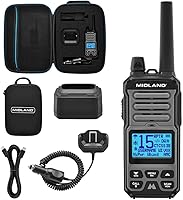
Midland GXT1000VP4 GMRS Radios, 2 Pack: Best family pair
- 50 channels and 142 privacy codes
- NOAA weather alert
- VOX hands free
- Runs on AA cells too
A ready pair for families and camping, with a desktop charger and the option to switch to AA cells when the pack runs down.
Pros
- Two radios and a charger in the box
- Dual power with AA cells
- Weather alert
Cons
- Fewer channels than the others
- AA cells add extra weight
The Midland GXT1000VP4 is the family pick here. You open the box to two radios, two battery packs and a desktop charger, so nobody argues over whose turn it is to charge.
Its 50 channels and 142 privacy codes keep separate groups apart on the same channel. The EVOX voice activation means you can talk while your hands stay on a fishing rod, a steering wheel or a ski pole.
The set also brings headsets, a belt clip for each radio and both an AC and a DC adapter.
Dual-power mode is the standout feature for a beginner. When the rechargeable pack runs low, switch to AA cells, which are easy to buy at any gas station.
The set is rated JIS4 water resistant and carries an SOS siren, keypad lock and vibrate mode.
The trade-off is channel count. Fifty channels is plenty for GMRS talk, but it is less than the 250 on the BAOFENG models.
The 10 hour battery figure is the lowest here. If you want to program a shelf of channels for different trips, take the GM-30 instead.
TIDRADIO TD-H3 Plus GMRS Handheld Radio: Best for app setup
- Bluetooth programming app
- 2500mAh battery
- One-tap repeater import
- Two-pack with chargers
Program it from a phone over Bluetooth, which skips the cable stage that slows most beginners down.
Pros
- Phone app programming
- Two radios and chargers
- Water resistant body
Cons
- App learning curve
- Fewer channels than the top picks
The TIDRADIO TD-H3 Plus is the pick for a beginner who is comfortable with a phone. Programming runs over Bluetooth through the Odmaster app, so you skip the cable and the PC step that trips up new users.
A one-tap GMRS repeater import pulls the local repeaters and their tones into the radio. For a convoy or a camping group, that means channels are set in minutes.
A built-in spectrum analyzer helps you find a clear GMRS channel and spot interference.
The 2500mAh battery and 199 channels cover the usual needs, and a 1.44 inch color screen names each channel. The 0.5 lb body slips into a pocket, and the two-pack includes chargers and earpieces.
The 50 CTCSS and 105 DCS codes keep groups apart, and the PC+ABS shell with a matte finish resists fingerprints and scuffs. It is rated for -20°C to 50°C and is FCC Part 95E certified.
The trade-off is the app dependence. If you would rather not learn an app, the GM-30 is simpler.
The 8-mile figure is a best case in open ground. If a phone is your normal tool, this is the fastest way to a working setup.
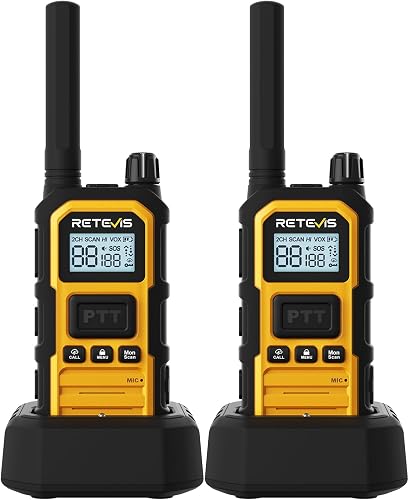
Retevis RB48 Plus GMRS Radios, 2 Pack: Best for wet weather
- IP67 waterproof
- 18-hour battery
- NOAA weather channels
- Vibration alert
A rugged pair for rain, sand and cold mornings, with a battery that lasts a full day of light use.
Pros
- IP67 waterproof rating
- Vibration alert
- Two radios with docks
Cons
- Setup runs on Windows CPS only
- Fewer channels than the others
The Retevis RB48 Plus is the wet-weather pick. Its IP67 water and dust rating and 2-meter fall rating suit rain, sand and cold mornings where other radios come home with grit in the keypad.
The 2000mAh battery gives 18 hours of use and a 100-hour standby, so a full day out rarely ends with a dead radio. NOAA weather channels come along for the planning.
Dual large PTT keys are easy to hold with gloves or wet hands.
Remote emergency alarm sends a distress signal to teammates on the same channel. Vibration alerts mean a call isn't missed in a noisy camp.
A button lock stops an accidental channel change from cutting the conversation short.
The trade-offs are the channel count and setup. This model has 30 channels, its repeater capability covers 8 channels, and its CPS software runs only on Windows.
A beginner on a Mac, or one who wants a wide channel list, should look at the UV-5G Plus. The 3-mile talking range figure is modest, so count on a repeater for distance.
Midland GXT67 PRO GMRS Radio: Best for vehicle spotting
- 5 W GMRS output
- Repeater capable
- IP67 waterproof
- Large backlit buttons
A single radio with big buttons you can press in gloves, made to pair with Midland mobile radios in a truck.
Pros
- Big glove-friendly buttons
- IP67 waterproof
- Travel case and car charger included
Cons
- One radio only
- Fewer channels than the top picks
The Midland GXT67 PRO is the spotter radio for a truck or Jeep. Its oversized buttons work in gloves, and the 5 W GMRS output cuts through a treeline or a valley on the trail.
Repeater support extends the reach by dozens of miles where local gear exists, and 22 channels plus 28 privacy codes cover the basics. IP67 waterproofing matches the weather you meet on a mountain road.
The display is backlit so it reads at dusk.
The package includes a travel case, a desktop charger, AC and DC adapters and a high-capacity battery rated for days on the trail. Midland pairs this radio with its MicroMobiles, so it fits a truck that already runs a mounted radio.
Call alert and silent operation round out the buttons.
The trade-off is that it's a single radio with 99 channels, and it's built to spot a driver rather than host a family. The 100-mile figure assumes ideal conditions and should be read as marketing, not a campsite promise.
For a first radio pair, take the GXT1000VP4.
How the beginner GMRS radios compare
The GM-15 leads on the balance of two radios, ready channels and weather alerts, while the UV-5G Plus leads on screen and battery for a single owner. The table sets the main specs side by side so you can match one to how you'll use it.
| Product | Best for | Channels | Power | Pack | Our score |
|---|---|---|---|---|---|
| BAOFENG GMRS Radio Handheld Long Range GM-15 | overall | 250 | Repeater capable | 2 radios | 9.5 |
| BAOFENG UV-5G Plus GMRS Handheld Radio | growing into the hobby | 999 | 1 radio | 9.4 | |
| Radioddity GM-30 GMRS Handheld Radio | simple menus | 250 | 5 W | 1 radio | 9.2 |
| Midland GXT1000VP4 GMRS Radios, 2 Pack | family pair | 50 | 2 radios | 9.1 | |
| TIDRADIO TD-H3 Plus GMRS Handheld Radio | app setup | 199 | 2 radios | 8.5 | |
| Retevis RB48 Plus GMRS Radios, 2 Pack | wet weather | 30 | 2 radios | 7.9 | |
| Midland GXT67 PRO GMRS Radio | vehicle spotting | 99 | 1 radio | 7.8 |
How these picks were compared
Our score weighs specs, features and how well each radio fits a first-time buyer. The best score goes to the model that needs the least setup and covers the most beginner needs.
We checked channels, battery, charging, weather coverage and repeater support against what a new GMRS user actually does in the first month.
Where a brand states a range figure, we note the terrain it assumes.
Two radios in the box counts for a lot here because a new owner usually needs a partner. A radio that needs a licence, a programming cable and a menu lesson before the first call loses points against one that talks out of the box.
Water ratings, app setup and glove-friendly controls are scored where they fit a named use, not across the board. A waterproof pair like the RB48 Plus scores well for wet weather without claiming a beginner's everyday crown.
The GXT67 PRO gets the same treatment for truck use.
Do you need a license before you buy a GMRS radio?
You do not need a license to buy one, but you do need one to transmit in the US. The FCC GMRS license covers your whole family for 10 years and needs no exam.
Listening is free. You can buy the radio, scan channels and learn the controls while the license is processed.
Program a repeater too early and you'll hear silence. Tones and offsets have to match what the repeater owner lists, so learn the channel first.
The Complete Baofeng & GMRS Radio Field Manual explains licensing, channel setup and CHIRP programming in one place if you want a book beside the radio. It runs 406 pages and covers privacy tones, repeaters and family comms plans.
What the license covers and what it doesn't
The license covers personal use by your household, not a business or a rented group. Kids and guests in your household fall under it.
GMRS is not a private service. Anyone with a compatible radio can hear you.
The privacy codes only filter what you hear, they don't hide your voice. A 50 CTCSS or 104 DCS code on the GM-15 changes what you hear, not who hears you.
When a free radio service makes more sense
FRS radios use the same UHF spectrum and need no license. They carry less power and no repeater access, so the range is shorter.
A family that wants simple camp chatter with no paperwork can start on FRS and move up later. A group that wants range and repeaters should get the license and the GMRS gear.
Which GMRS radio suits your first setup?
Start with the need, not the feature list. A family camping trip, a solo driver and a hiker who walks in rain each want a different radio.
A family wants two radios and a simple charge, so the GXT1000VP4 or GM-15 fits. A solo owner who wants a large screen and repeater room should look at the UV-5G Plus.
Anyone who will be in heavy rain, sand or cold should pay for the IP67 pair. That means the RB48 Plus or the GXT67 PRO.
For the truck side of the plan, our best GMRS mobile radio guide covers the mounted units that extend a handheld group's reach.
For a family or a camping group
Two radios and a charger are the basics. The GM-15 and GXT1000VP4 both deliver that without extra buys.
The GM-15 adds repeater channels and weather alerts. The GXT1000VP4 adds AA backup and a bigger channel list with privacy codes.
The GM-15 brings 154 privacy codes against the Midland's 142, and its 250 channels against the Midland's 50.
If the group splits across two cars, buy two pairs so each car has a handset and a spare. The TD-H3 Plus is the other two-pack option, and its app setup pays off when you need to load repeaters for a trip.
For a driver or a solo camper
One good radio with a long battery is better than two budget units. The UV-5G Plus and its 2500mAh battery cover a full weekend, and the color screen is easy to read in daylight.
Its frequency copy feature means a borrowed second radio takes seconds to match.
If the truck already has a mounted Midland radio, the GXT67 PRO is the natural handheld to go with it. Its glove-friendly buttons and car charger fit the driving job.
It also comes with the travel case and car adapter that a weekend trail kit needs.
For trail runs and overland trips, the GMRS radio for off roading picks cover mounts, antennas and power.
What separates a beginner-friendly GMRS radio from a hard one?
Channels set from the factory, a simple charge and a screen you can read. Those three things decide whether a new owner is talking in 10 minutes or reading a manual for an hour.
Almost everything else is a nice extra. Weather, repeater support and water ratings add value without making the first call harder.
A radio with a hundred features and a menu tree can still be the wrong first buy. The easy path is the one with a preset channel and a clear display.
Factory channels versus custom programming
A factory GMRS radio comes with the standard channels preloaded. You can talk on channel 1 with another GMRS radio without touching the menu.
The GM-15 and GM-30 both ship this way.
A programmable radio like the UV-5G Plus adds hundreds of slots for repeaters and custom channels. That flexibility waits until you want it, which is the right order.
Its 969 customizable channels sound intimidating but sit idle until you program them.
Custom programming only pays off if you will travel across regions and set up different repeaters along the way. At home, the preset channels cover most talk.
For most beginners, the first month is about learning the PTT key and the volume knob, not the channel editor.
Batteries, charging and weather
USB-C charging from a power bank is the modern convenience. It means one cable in the car covers the radio and the phone.
The GM-15, UV-5G Plus, GM-30, TD-H3 Plus and RB48 Plus all charge this way.
An AA backup, as on the GXT1000VP4, is the low-tech safety net. It saves a trip when the rechargeable pack dies far from an outlet.
A weather alert on a GMRS radio is worth real money during storm season. Check that the model lists NOAA channels before you rely on it.
The GM-15, GM-30, GXT1000VP4, RB48 Plus and TD-H3 Plus all carry weather reception.
Range and repeaters
A handheld's range to another handheld is a few miles at best in open ground. Trees, buildings and hills shorten it.
That is why the same radio can claim 4-5 miles in a field and 2-3 miles in town.
Repeaters change the math. One repeater on a hill can carry a signal dozens of miles, which is why repeater channels matter in the long run.
The Midland GXT67 PRO and the GM-15 both list repeater capability, and the UV-5G Plus lets you pre-set repeaters for several towns before a trip.
Our GMRS radio range guide explains the realistic numbers by terrain and gear.
Verdict
The best GMRS radio for beginners is the BAOFENG GM-15 two-pack. You get two ready radios, weather alerts and a USB-C charge for one purchase, and nothing stands between you and the first call.
That mix wins for most new users, whether the plan is a family camp or a weekend trail.
Choose the UV-5G Plus if you'd rather have one radio with a big color screen and years of room to grow. The Radioddity GM-30 is the pick for clean menus on a single unit.
Buy the Midland GXT1000VP4 for a family that wants simplicity and an AA backup. The TIDRADIO TD-H3 Plus is for a phone-first user, and the RB48 Plus covers wet weather.
The GXT67 PRO belongs in a truck that already has a mounted Midland radio.
Start with the setup closest to how you'll use the radio, and get the license in motion while you learn the buttons.
Our top 3 picks at a glance
-
1
-
2
Best for growing into the hobby
BAOFENG UV-5G Plus GMRS Handheld Radio
9.4/10 our score
See it on Amazon -
3
Frequently asked questions
Do beginners need a GMRS license?
Yes, in the US you need an FCC GMRS license to transmit on GMRS channels. It covers your whole family for 10 years.
Receiving and listening needs no license.
Can a beginner just turn on a GMRS radio and talk?
On these radios, yes. The BAOFENG GM-15, Radioddity GM-30 and Midland GXT1000VP4 all arrive with the standard GMRS channels preset, so you press the button and talk on a shared channel.
How far will a beginner GMRS radio reach?
Expect about 2 to 5 miles handset to handset in open ground, depending on trees and buildings. A repeater is what turns that into dozens of miles.
Our GMRS range guide walks through the numbers.
Is a two-pack better than buying one radio?
A two-pack is the better first buy for most beginners. A radio only helps if someone else is on the other end, and the second unit doubles as a spare for a hiking partner or family member.
What is a repeater channel for?
A repeater is a shared antenna on high ground that rebroadcasts your signal. Radios with repeater channels can use that shared gear to talk much farther than handset to handset.